Typical Air Leak Investigation Pricing and Market Trends
In manufacturing, air leaks are a hidden factor that drives up energy costs across an entire factory. As much as 20% of compressor power consumption is lost to air leaks, and attention to air leak investigation is rising rapidly as a way to solve this problem.
Key Factors That Influence Investigation Cost
The cost of an air leak investigation varies considerably depending on several factors. The most significant is factory size: cost is largely determined by building floor area and the range of equipment to be inspected. The grade of diagnostic equipment used is also directly tied to cost.
Impact of factory size
From small factories (under 1,000 square meters) to large factories (over 10,000 square meters), the investigation area expands in proportion to building floor area, so cost rises in stages.
Type of diagnostic equipment
The grade of equipment — ultrasonic detectors, acoustic cameras, and so on — changes detection accuracy and work efficiency, and that difference shows up in the cost.
Level of investigation detail
From a basic investigation that only pinpoints leak locations, to a detailed investigation that also quantifies leak volume and calculates the annual loss cost, the breadth of service scope causes the cost to vary.
Market Perception of Cost-Effectiveness
The market rates air leak investigation as a highly cost-effective investment. Depending on factory size and leak conditions, some cases lead to cost reductions on the scale of several million yen per year, and for many companies there is a strong possibility of recovering the investigation cost in a relatively short period.
Today, many investigation providers offer free on-site consultations and simple estimates, so a company can confirm specific costs and benefits in advance. Finance managers can gather enough information for an investment decision before moving the review forward.
The heart of the investigation is "visualizing" leak locations and "quantifying" the loss volume and loss amount. The accuracy and level of detail of these tend to be reflected directly in the cost.
Detailed Cost Breakdown and Components of an Air Leak Investigation
To grasp the cost of an air leak investigation accurately, it is important to understand what elements make it up. The investigation cost is not a single line item but a combination of multiple elements, and once you understand the content of each, you can judge whether an estimate is valid.
Basic Cost Structure
The cost of an air leak investigation is mainly made up of three basic elements. They vary with the scale and content of the investigation, but they are cost items common to any investigation.
Travel and transportation costs
This covers the transportation and accommodation expenses for the diagnostic technician to reach the site. It varies greatly with the factory's location and the number of investigation days. For distant factories or multi-day investigations, this portion increases.
On-site investigation and diagnostic costs
This is the cost of the actual measurement and inspection work at the site. It is determined by the grade of diagnostic equipment, the breadth of the investigation scope, and the number of days required. When high-precision equipment such as ultrasonic detectors or acoustic cameras is used, this portion is higher.
Report preparation and analysis costs
This is the cost of analyzing the investigation results, preparing the report, and organizing the data. For a detailed report that includes not only simple leak-location identification but also quantification of leak volume, calculation of annual loss cost, and assessment of repair priority, this portion increases.
Cost Variation from Value-Added Services
In addition to the basic investigation, the following value-added services may be offered, and these affect the cost.
Data visualization service
A service that maps leak locations onto floor plans and displays them in an easy-to-understand visual form. It is an important element for streamlining on-site repair work.
Quantifying the loss cost
A service that calculates a specific annual loss amount for each discovered leak location and makes the cost-effectiveness of repair clear. It becomes indispensable material for a finance manager's investment decision.
Calculating CO2 emissions
A service that quantifies the CO2 emissions caused by air leaks from an environmental standpoint. It is an important metric for companies pursuing environmental management and carbon neutrality.
Once you understand these components, you can judge whether the estimate presented is appropriate and choose investigation content that matches your company's needs.
Return on Investment and Economic Benefits of Air Leak Investigation
An air leak investigation is not merely an expense but a strategic investment that delivers significant cost reductions in the future. By appropriately repairing the air leaks discovered through the investigation, you can eliminate compressed-air waste and substantially improve the operating efficiency of the compressor. Continuous electricity-bill savings follow, and many companies have a track record of recovering the investigation cost in a short period.
Examples of Specific Reduction Results
On real manufacturing sites, there are reported cases where an investigation revealed, in numbers, loss costs that had been overlooked, and repairing most of them led to steady cost reductions. A major value of the investigation is that by visualizing and quantifying leak volume, you can judge where to start for the highest cost-effectiveness.
In an even more striking example, a company that carried out air leak countermeasures together with standby-power measures succeeded in a major electricity-cost reduction of 5.6 million yen per year. These cases demonstrate the high return relative to the investigation cost and make for an attractive investment in the eyes of a finance manager.
Factors That Shorten the Payback Period
The reason an air leak investigation offers such a high return lies in the magnitude of the losses it uncovers. In many factories, small leaks that occur day to day pile up and create losses far larger than imagined.
Discovering hidden losses
Even minute leaks that conventional visual or auditory inspection could not catch can be precisely identified with specialized diagnostic equipment. When these minute leaks accumulate, it is not unusual for the annual loss to reach the scale of several million yen.
Clarifying priorities
Once leak volume and loss amount are quantified through the investigation, repair priorities can be clearly decided. You can build a strategic repair plan that achieves the greatest effect within a limited budget.
This "quantifying of leak volume and loss cost" can be done right there on the shop floor with the acoustic camera ALGOLEAK AL64. Just power it on and point the camera, and it visualizes leak locations as a red heat-map and automatically displays leak volume (L/min), loss cost (¥/year), and CO2 emissions on the screen — so even without specialist knowledge you can judge repair priorities.
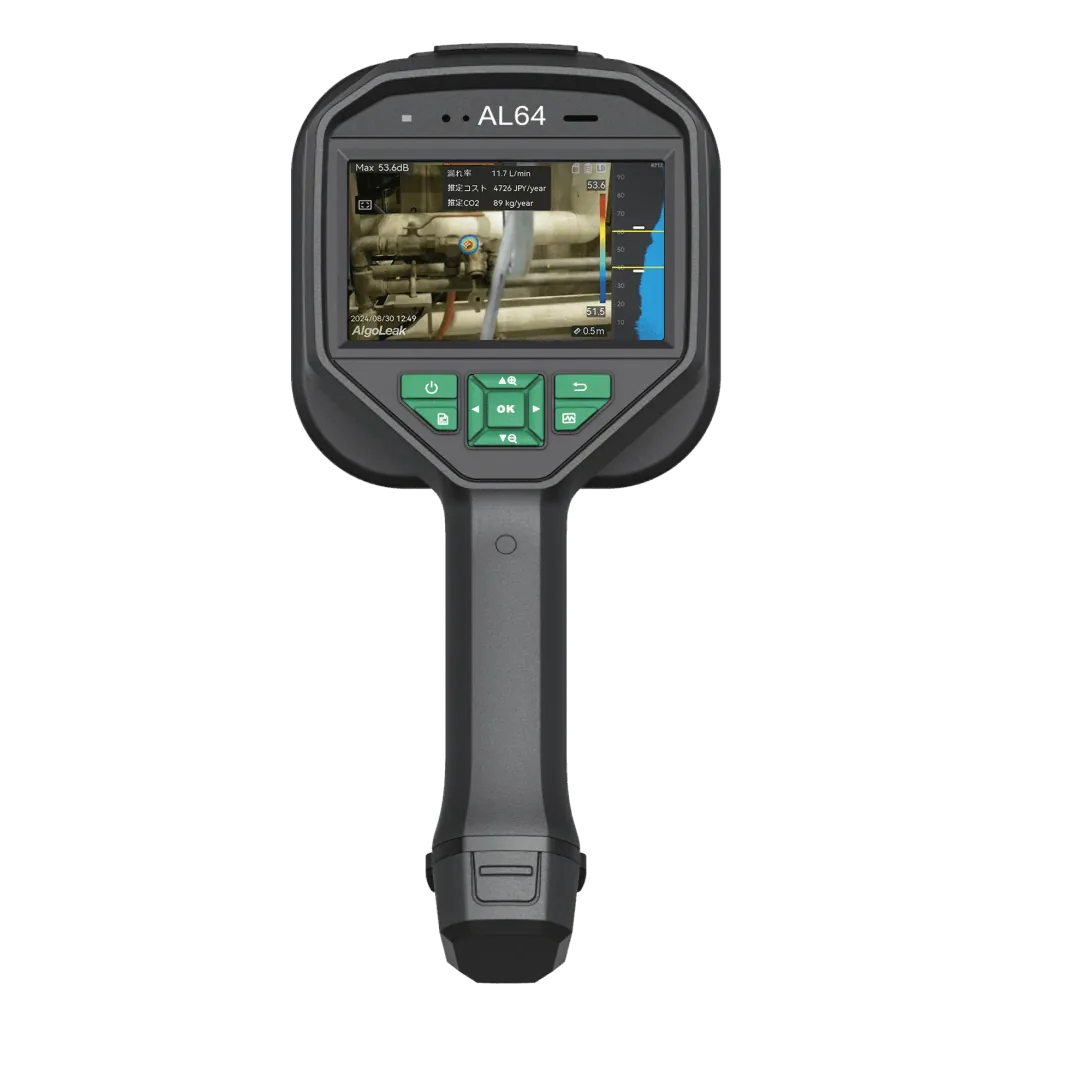
Acoustic Camera ALGOLEAK AL64
Power on and point the camera / 940 g lightweight handheld / Made in Japan
- Automatically visualizes leak locations as a red heat-map (no expertise required)
- Leak volume, loss cost, and CO2 displayed live on screen
- Detection range 0.3 m – 150 m / minimum 0.008 L/min (6 bar, 0.5 m)
- Free LEAK ANALYZER analysis software included
Added Value Through Secondary Effects
The effects of an air leak investigation are not limited to direct cost reductions. When loss amounts are shown as concrete figures, energy-saving awareness among shop-floor workers and managers rises substantially. This change in awareness tends to increase proactive efforts and improvement proposals for energy-saving activities beyond air leaks.
There is also a major benefit from an environmental standpoint. Because reducing air leaks directly translates into lower CO2 emissions, it contributes to a company's environmental management and carbon-neutrality initiatives. These environmental effects also hold important value in light of future carbon-tax measures and environmental-regulation compliance.
With the dual effect of reduction benefits that exceed the investigation cost and a sustained rise in energy-saving awareness, an air leak investigation is an extremely cost-effective investment.
The Reliable Return on Investment from an Air Leak Investigation
An air leak investigation occupies an extremely important position as an investment for cutting a factory's energy costs. Given the reality that as much as 20% of compressor power consumption is wasted on air leaks, the investigation cost is more than worthwhile as a strategic investment that delivers significant future cost reductions. At AirMore Co., Ltd., we achieve high-accuracy diagnosis even while the factory is operating, and we clearly support our customers' investment decisions by visualizing annual loss cost and CO2 emissions.
Many companies have a track record of recovering the investigation cost in a short period, and cases of major cost reductions exceeding several million yen per year have been reported. In particular, AirMore's diagnostic service not only pinpoints leak locations but also prepares a loss-calculation sheet and quantifies repair priorities, providing an environment in which a finance manager can accurately grasp cost-effectiveness. Because an investigation raises shop-floor energy-saving awareness and a ripple effect can be expected on improvement activities beyond air leaks, the investment value rises even further.
Achieving "Discover → Repair → Continuous Management" with AirMore's Products and Services
After an investigation or diagnosis has "visualized" the leaks, the cost-reduction effect only takes hold once you complete the three steps of (1) Discover (inspection) → (2) Repair → (3) Continuous management. AirMore offers products and services that support these three steps end to end.
① Discover: ALGOLEAK AL64 Acoustic Camera
64 MEMS microphones visualize leaks. Loss cost shown in real time — repair priority decided on the spot.

② Repair A: UV-Curing LEAKAID
Cures in about 1 second under UV light. For spot-repairing pipe cracks and pinholes. Food Sanitation Act compliant.

② Repair B: Silicone Tape LeakStopper
Just wrap to fuse instantly. No power or tools needed — ideal for emergency repair of pipe connections and hoses.
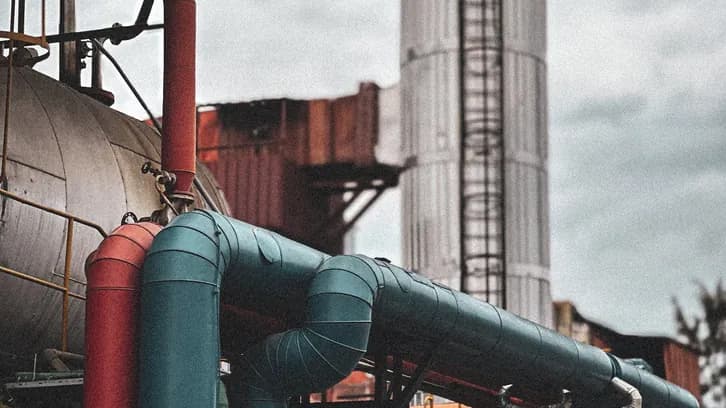
③ Diagnostic Service: On-Site by Pros
While your factory keeps running, we deliver a quantified report on leak locations, loss cost, and CO2 emissions.

④ Continuous Management: Visualize with AirHub
Constantly monitor compressed-air consumption, cost, and CO2 — supporting relapse prevention and ongoing improvement.
+ Full Product Lineup
See AirMore's entire product range — acoustic cameras, valve diagnostics, repair materials, thermography, and more.
View all products →