The Evolution of Visualization Technology in Air Leak Detection and the Latest Methods
Air leaks in factories and plants cause energy losses and increased equipment load, and if left unaddressed they lead to a substantial rise in costs. To meet this challenge — where conventional detection methods reached their limits — technological innovation has produced efficient, high-precision detection approaches.
▶ Related: What Is Air Leak Visualization? How it works, 3 detection methods, and how to choose
Challenges Facing Conventional Detection Methods
The limits of visual and listening-based detection
In a noisy factory environment, faint leak sounds simply cannot be heard. Working at heights or in cramped spaces carries safety risks, and because detection accuracy depends on each worker's experience and skill, results vary widely.
Problems with soap-water detection
Depending on the shape and location of the piping, soap water can be hard to apply, and on vertical pipes the liquid simply runs off. Inspecting a wide area also takes time, and it often requires the equipment to be shut down, which hurts production efficiency.
Innovative Detection Systems Powered by Acoustic Technology
The detection systems drawing the most attention today are those based on acoustic technology. Special sensors capture the high-frequency sound generated by escaping air and turn information in a sound range inaudible to the human ear into a visual image.
Precise detection with ultrasonic sensors
The latest ultrasonic sensors display sound information as an image, so leak locations can be grasped intuitively. Even complex piping systems can be surveyed efficiently in a short time, and real-time visualization has dramatically streamlined inspection work.
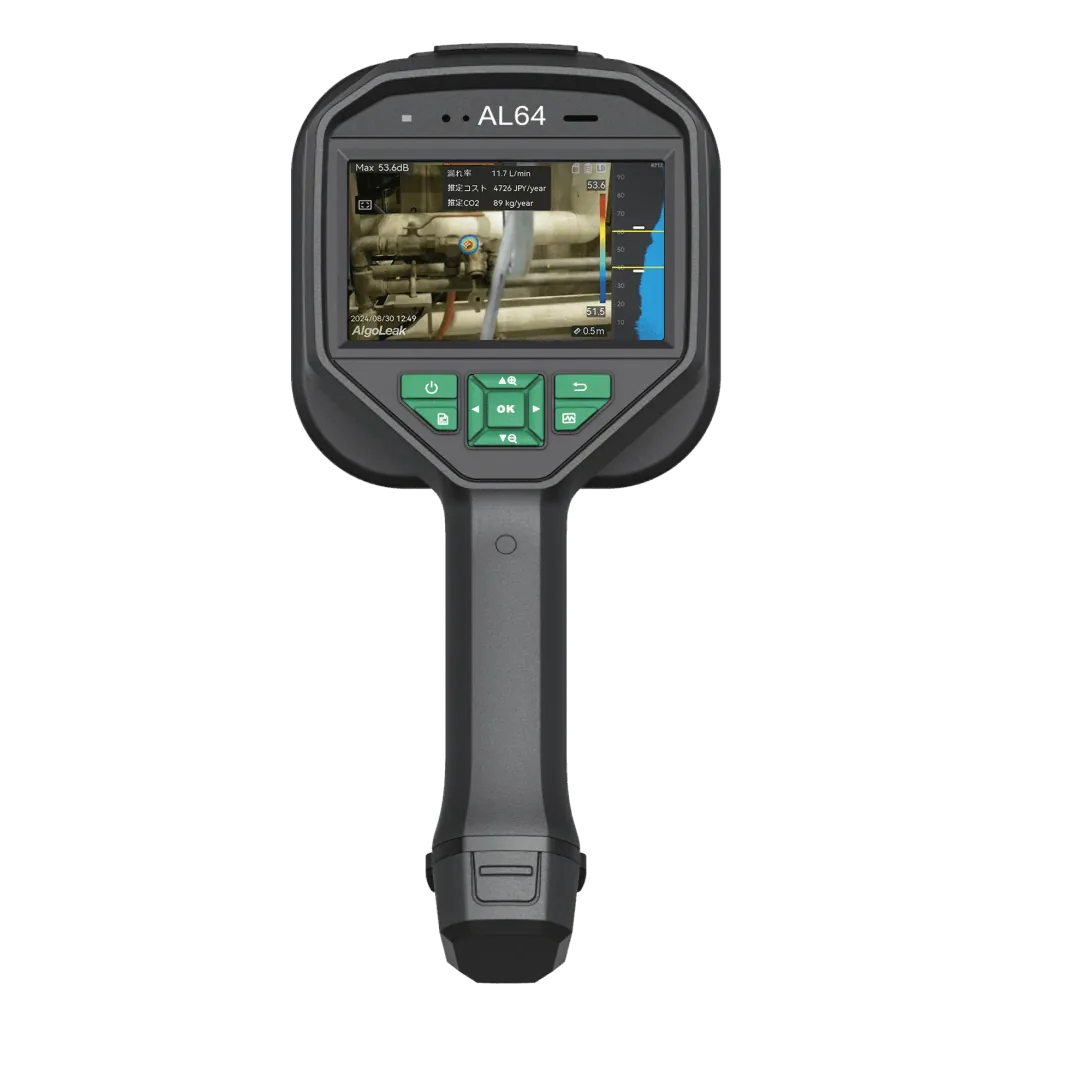
Acoustic Camera ALGOLEAK AL64
Power on and point the camera / 940 g lightweight handheld / Made in Japan
- Red heat-map automatically visualizes leaks (no expertise required)
- Leak volume, loss cost, and CO2 displayed live on screen
- Detection range 0.3 m – 150 m / minimum 0.008 L/min (6 bar, 0.5 m)
- Free LEAK ANALYZER analysis software included
The major benefit of inspecting equipment while it runs
Unlike conventional methods, inspection can be performed while equipment is in operation, without any shutdown. Because the impact on production lines is kept to a minimum, this is extremely valuable for manufacturers, and it makes routine inspections far easier to carry out.
Comparing Detection Methods and Key Points for Choosing
Each detection method has its own characteristics, and the optimal approach changes with the factory environment and the inspection target. Outdoor equipment is easily affected by wind, so care is needed — but by properly adjusting the sensor's orientation and angle and scanning carefully, accurate detection is still possible.
Building a Cost-Reduction Strategy Through Air Leak Repair
Air leaks are a primary cause of energy loss in compressed air systems. Compressed air accounts for a significant share of a factory's total electricity consumption, and much of that is wasted through air leaks. Strategic air leak repair must be treated as a management issue that goes beyond mere equipment maintenance.
The Reality of the Economic Losses Air Leaks Create
Direct increases in energy cost
Compressors keep running extra to make up for what leaks away, generating power consumption that should never have been necessary. The more the leakage, the longer the compressor runs and the higher the electricity bill climbs. With electricity prices currently soaring, this impact is too large to ignore.
Secondary harm to equipment
Continuous overload operation shortens the life of the compressor itself and raises the risk of breakdown. To maintain the required pressure, more energy is consumed, and the efficiency of the entire facility declines.
Planning a Repair Strategy Focused on Return on Investment
Set ROI-focused decision criteria
By comparing the annual loss cost at each leak location with the cost of repair and calculating the payback period, you can build a repair plan that makes sense from a management standpoint. Tackling the locations with the highest expected return on investment first delivers reliable results.
Improve efficiency with a phased rollout
There is no need to repair every leak at once. By accounting for financial constraints and available labor resources and proceeding in phases, you can steadily accumulate results within a realistic scope.
Optimizing Repair Priorities with Visualization Technology
One of the most important challenges in air leak repair is deciding which locations to fix first within limited resources. By using the latest detection technology, you can take a systematic approach grounded in quantitative evaluation and maximize the effect of your repairs.
Building a Comprehensive Evaluation System with Multi-Angle Data
Achieving quantitative loss evaluation
The data obtained from detection technology includes concrete figures for leak volume and the estimated annual loss cost. You can accurately grasp the economic impact each leak location has on the entire factory and identify the repair points with the highest return on investment.
Strategic planning through a comprehensive grasp of the situation
You can comprehensively grasp the leak situation across the whole factory — including the minute leaks that were previously overlooked and leaks in hard-to-access locations. Rather than piecemeal measures, you can devise an efficient repair strategy that considers the system as a whole.
Determining Priorities Through Matrix Analysis
An evaluation standard based on economic impact
Prioritizing by the size of the annual loss cost lets you identify, within a limited repair budget, the locations that will deliver the greatest effect. Addressing the leaks generating the largest losses first produces fast-acting cost reductions.
Accounting for technical repair difficulty
Technical factors such as the position of the leak, the structure of the piping, and the labor time required are also important judgment criteria. Locations that are easy to access and can be repaired quickly offer high cost-effectiveness, so their priority can be raised.
Making Use of Effect Measurement and a Feedback System
Measuring the effect after a repair is completed is indispensable for improving the accuracy of future strategy. By accumulating the data obtained through detection technology and using it to verify repair results and extract points for improvement, you can build a sustainable cycle of continuous improvement.
Putting Visualization Technology into Practice and Using It Effectively
To minimize the losses caused by air leaks and achieve factory energy savings, a systematic approach powered by visualization technology is essential. By moving away from intuitive judgment and building a data-driven repair strategy, you can realize major cost-reduction effects.
AirMore Co., Ltd. provides an air leak diagnostic service that harnesses cutting-edge visualization technology, accurately pinpointing and quantifying leak locations even while the factory is running, and clearly visualizing annual loss cost and CO2 emissions. Thanks to high-precision detection technology, we discover even the minute leaks that had been overlooked and clarify repair priorities, delivering efficient air leak countermeasures.
If you are struggling with air leak countermeasures, start by accurately grasping your current losses. AirMore's specialist staff will propose the optimal diagnostic plan tailored to your factory's situation.
Achieve "Discover → Repair → Continuous Management" with AirMore's Products & Services
Once visualization has "discovered" the leaks, stop them with the right repair material and keep them under continuous management with AirHub. AirMore offers products and services that support all three steps — (1) Discover (inspection) → (2) Repair → (3) Continuous management — end to end.
① Discover: ALGOLEAK AL64 Acoustic Camera
64 MEMS microphones visualize leaks. Loss cost shown live on screen — repair priority decided on the spot.

② Repair A: UV-Curing LEAKAID
Cures in ~1 second under UV light. Perfect for spot-repairing pipe cracks and pinholes. Food Sanitation Act compliant.

② Repair B: Silicone Tape LeakStopper
Wrap to fuse instantly — ideal for emergency repair of pipe connections and hoses, no power or tools required.
③ Diagnostic Service: On-Site by Pros
While your factory keeps running, we deliver a numerical report on leak locations, loss cost, and CO2 emissions.

④ Continuous Management: AirHub Visualization
Continuous monitoring of compressed-air consumption, cost, and CO2 — for relapse prevention and ongoing improvement.
+ Full Product Lineup
Acoustic cameras, valve diagnostics, repair materials, thermography, and more — see AirMore's entire product range.
View all products →