The quick-release couplers used throughout factory air piping are one of the places where leaks most easily appear at the connection. On top of that, when a coupler is disconnected the residual pressure inside the hose can whip the hose or plug back — a safety concern in its own right. How do you stop the leaks at a coupler? How do you prevent the recoil on disconnection? This case study shows how an aircraft parts manufacturer used an air leak survey as the trigger to review its couplers, and improved both safety and energy saving with the PREVOST safety coupler "prevoS1".
Key points of this case study
- An air leak survey found several leaks at the coupler connections around the machining centers
- Some points kept leaking a small amount of air even on standby, with no blow gun connected
- Pressing the button first bleeds the residual pressure and only then releases the plug, suppressing hose recoil
- One-handed connection and release keeps post-machining cleaning and changeovers efficient
- A follow-up check with an acoustic camera confirmed that the ultrasonic response at the coupler connections was gone
Do you know where — and how much — your couplers are leaking?
Free consultation →- Industry
- An aircraft parts manufacturer
- Target equipment
- Machining area for aircraft parts (coupler connections around the machining centers)
- Challenge
- Air leaks at the coupler connections; on disconnection, residual pressure could whip the hose or plug back, risking contact with machines and precision parts
- Objective
- Reduce air leaks while preventing hose recoil caused by residual pressure
- Product used
- PREVOST safety coupler "prevoS1"
Background: blow guns and pneumatic tools in an aircraft parts machining area
In the machining area for aircraft parts, blow guns and pneumatic tools were used to remove chips and cutting fluid after machining.
Because these tools are attached to the hose with couplers, every connection point is a potential source of leakage. They are also connected and disconnected daily, so wear and loss of seal tightness are common.
The challenge: leaks at the coupler connections and hose recoil from residual pressure
When an air leak survey was carried out, several leaks were confirmed at the connections of the couplers installed around the machining centers. At some points, a small amount of air kept leaking even on standby, with no blow gun connected.
In addition, when a coupler was disconnected for cleaning or a tool change, the residual pressure inside the hose could whip the hose or plug back, raising concerns about contact with the machines and precision parts.
In an aircraft parts machining area, even a small scratch or a piece of foreign matter affects quality, so it is important never to let hoses or tools touch the workpiece carelessly.
However, if safety is pursued to the point where connecting and disconnecting takes longer or requires both hands, the efficiency of post-machining cleaning and changeovers drops.
- Air leaks — several leaks at coupler connections, with some leaking even on standby.
- Recoil from residual pressure — on disconnection the hose or plug could whip back, risking contact with machines and precision parts.
- Loss of efficiency — slow or two-handed operation reduces the efficiency of cleaning and changeovers.
What was needed was a coupler that keeps leakage down, prevents hose recoil from residual pressure, and is easy for the operator to handle.
The solution: the prevoS1 safety coupler, which bleeds residual pressure before release
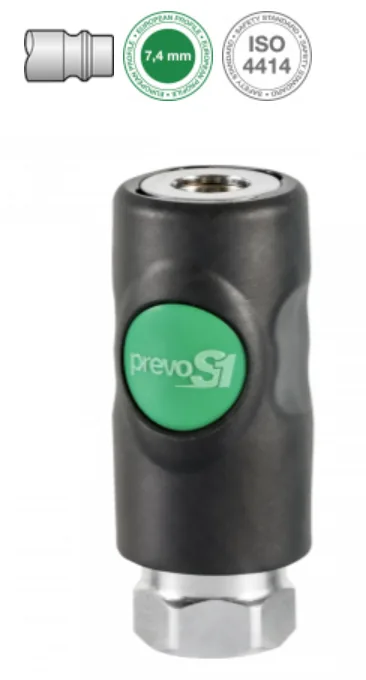
We therefore proposed the PREVOST safety coupler "prevoS1".
Because pressing the button first bleeds the residual pressure inside the hose and only then releases the plug, the sudden hose recoil on disconnection is suppressed. And since it connects and releases with one hand, it does not compromise the efficiency of post-machining cleaning and changeovers.
To start with, the connections around the machining centers — those used most frequently and where leaks had been confirmed — were replaced on a trial basis.
- Two-stage release — residual pressure is bled before the plug is released, suppressing hose and plug recoil.
- One-handed operation — even with repeated connection for cleaning and tool changes, the operator barely breaks stride.
- Prioritized, partial rollout — start with the frequently used connections where leaks were confirmed, verify the effect, then expand.
| Comparison | Conventional coupler | prevoS1 safety coupler |
|---|---|---|
| Residual pressure on disconnection | Residual pressure inside the hose can whip the hose or plug back | Pressing the button first bleeds the residual pressure and only then releases the plug, suppressing sudden recoil |
| Ease of operation | Once both hands are required, cleaning and changeovers become less efficient | Connects and releases with one hand; operators switched over from the previous product without discomfort |
| Leakage at the connection | Some points kept leaking a small amount of air even on standby | On the follow-up check after replacement, the ultrasonic response detected at the coupler connections was gone |
Results: lower contact risk and leaks cleared at the same time
After the switch, hose recoil on disconnection was suppressed, reducing the risk of contact with the machines and precision parts.
Operators commented that "it is reassuring that the pressure is released before it comes off" and that "it works with one hand, and we switched over from the previous product without any discomfort".
A follow-up check with an acoustic camera after replacement confirmed that the ultrasonic response previously detected at the coupler connections was gone. Today, based on the results of regular air leak surveys, priorities are set by leak volume and frequency of use, and the rollout is continuing across the other machining equipment.
- Better safety — recoil on disconnection is suppressed, lowering the risk of contact with machines and precision parts.
- Peace of mind on quality — less chance of hoses or tools touching the workpiece carelessly.
- Efficiency maintained — one-handed operation keeps cleaning and changeovers moving.
- Leaks cleared — the follow-up check found no remaining ultrasonic response at the coupler connections.
- A planned rollout — priorities set by leak volume and frequency of use, expanding to other machining equipment.
Summary: an air leak survey is a good trigger to review your couplers
Because couplers are connected and disconnected every day, they can become a source of leakage without anyone noticing. An air leak survey that shows where and how much air is escaping makes it clear which connections to tackle first.
The advantage of a safety coupler is that the replacement needed to stop those leaks can be carried out together with improvements in safety and ease of work. What starts as an energy saving measure also improves safety and quality on the shop floor.
Start by finding out how much air your factory is losing
Ask about an air leak survey →